

Welcome to Palo Pori, a cozy and quiet village, where the villagers enjoy culinary delights of all flavors. In Beastro, you play as Panko, a talented young chef who helps run the local Palo Pori restaurant. But on the morning we meet this budding cook, Panko’s teacher and restaurant chef, Travers, has disappeared, and a strange visitor – a magical flame spirit named Flambe – has arrived with an injury and a disturbing message about the danger brewing outside the village walls. It’s up to Panko and Flambe to work together to save their home the only way they know how: by cooking of course!
The tastiest part of Beastro is the storyline – and the characters that accompany it. The player is welcomed into a one-of-a-kind universe of friendly creatures using cleverly named ingredients to concoct magical food that can fight off evil monsters. What’s not to like? The spirits, guardians, and villagers you encounter have all been shaped by the creators with their own unique, fully formed personalities. For me, there was the potential to explore the world that had been created a little further. But I wanted more, which isn’t a bad thing.
Beastro throws many different playstyles, like ingredients, into the frying pan. Each morning begins with an open-world adventure around the delightfully bustling village of Palo Pori, where people farm, chat, fish, and generally gather ingredients. Then you’re at the restaurant and preparing food for your customers by completing a variety of fun mini-games. Following this, you are tasked with preparing a special magical meal for one of the guardians before he leaves the village to fight monsters.

Here, you prepare a meal with balanced flavors for them from your available ingredients – this will form your deck of cards for the fight later. You then end the day with the caretaker telling the story of his adventures with a quirky puppet show. For this section, you play as the guardian to defeat the monsters in card-based battles using the deck you prepared yourself at the restaurant earlier.
Overall, it looks like a lot of moving parts. But in reality, the whole thing is very satisfying. The variety of playstyles combine beautifully, resulting in a fusion of game flavors, each perfectly complementing the next. The diversity of activities available to the player keeps things fresh, and I found myself looking forward to the routine of each day of play. Impressively, each of the distinct gameplay elements perform to the same standard – each is individually well-formed and engaging, without any single section letting the others down. Special mention must go to the mini-games which were both entertaining and challenging – just when you feel like you’ve mastered the game, a new mechanic is added that spices things up again.

At Beastro, everything revolves around enhancing and/or balancing the five main flavor groups; sweet, salty, sour, bitter, umami – and a cheeky sixth; spicy. Flavors aren’t just limited to cooking: they’re used in combat, they define the regions the guardians travel to, and characterize the monsters you fight. Even the guards’ personalities are defined by the flavor of the region they come from. The complete infusion of this flavor theme into every aspect of the game’s narrative and mechanics shows the amount of love and effort that must have gone into its creation. And it really pays off, immersing the player in this taste sensation of a universe.
Beastro is characterized by a wonderfully sumptuous use of colors. From the vibrant cartoon visuals of the buildings, creatures, and ingredients found in Palo Pori Village, to the playful and imaginative 2D illustrations of the puppet show’s combat sections, the images in this game are charming and appealing to the eyes.
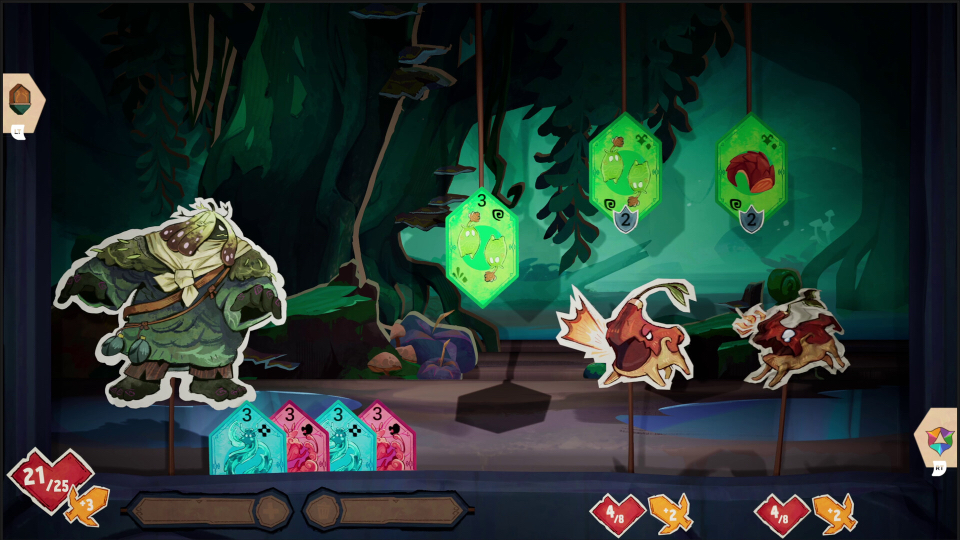
The combat section itself is fun and satisfying to play and has a lot of personality. Although they seem quite confusing during the initial tutorial, the basic rules are refreshingly simple, especially for a deck-building game. The goal is to match the color and strength of the enemy card with one of your own cards, or better yet, reduce the power of the enemy card with a balancing flavor card. On top of that, the guardians, meals, and ingredients you use can add upgrades and bonus abilities. Additionally, you receive higher levels on all levels as you explore the world, unlocking and upgrading items in the village. The upgrades can start to make later levels a little too easy to crush, but overall the combat is well doable without much setback.
My only complaint was the introduction of new acting characters that replaced the previous ones. At one level of the game, I saw no benefit in using the first Guardian character, Oyshi, whose attacks weren’t as powerful as those of later Guardians. A small drawback perhaps – but it would have been nice to evolve the individual guardians so that the player could take on the monsters with their favorite challenger.

