


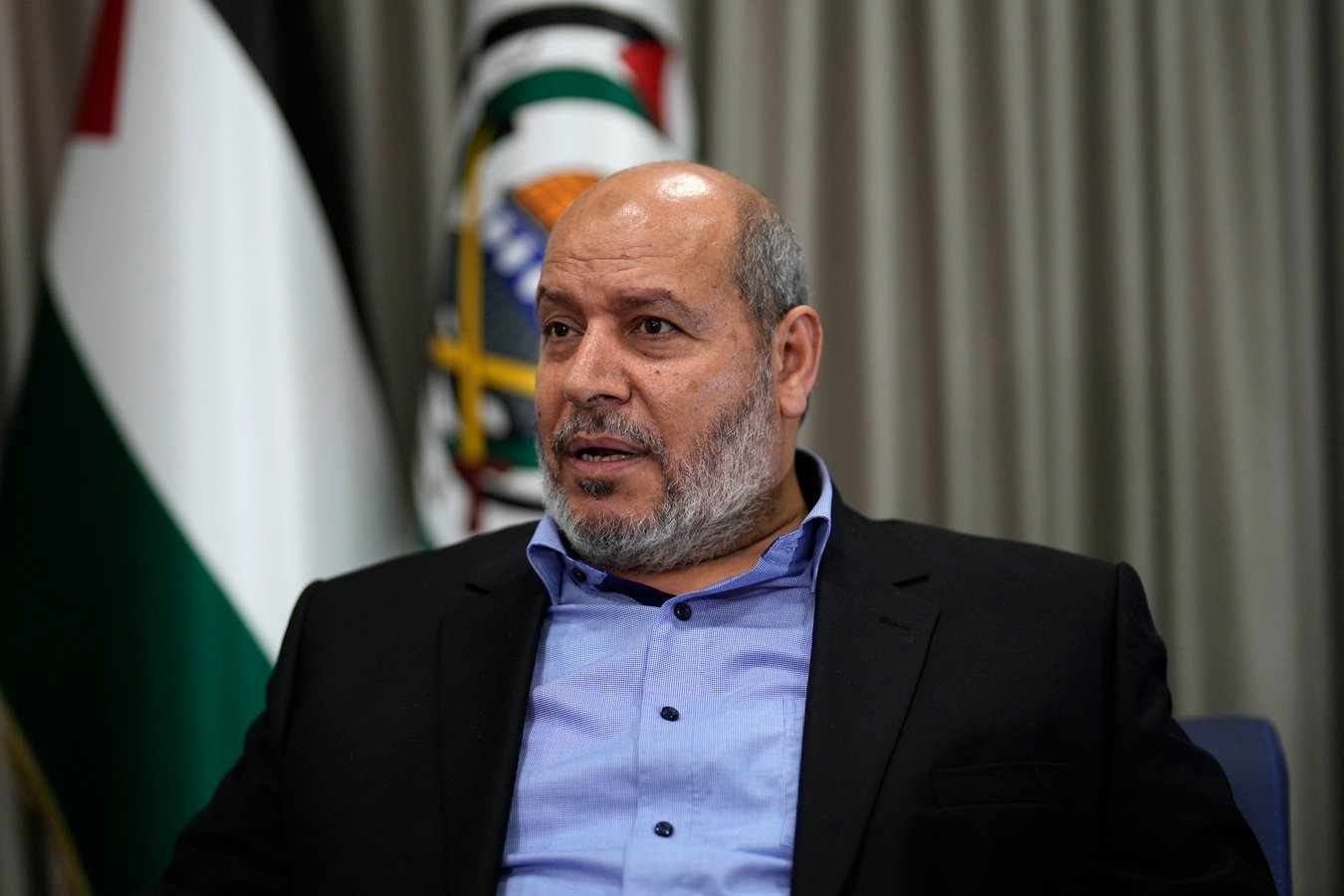
DOHA – Speaking from exile on the Hamas-run Al-Aqsa TV on Tuesday, Khalil Al-Hayya looked directly into the camera and told Palestinians in Gaza he saw them. Not as stated in the statistics or casualties in the Ministry of Health data, but as people sleep under the open sky. “You live in tents and temporary shelters, where the earth is your bed and the sky is your cover,” he said. Then he promised that no one who had witnessed the past nine months of ceasefire stasis could fully believe: He would bring them home.
This was the first public speech given by the new political leader of Hamas since his election on Sunday by a majority of one vote, and the speech covered the movement’s entire agenda in the language of resistance and diplomacy. Al-Hayya pledged to rebuild Gaza, release Palestinians detained in Israeli prisons, and establish a unified Palestinian state extending from Gaza across the West Bank to East Jerusalem as its capital. He said about the Palestinian flag, “until it flies over Al-Aqsa Mosque and the lands of free and proud Palestine.” His voice carried the special weight of a man who paid for those words with everything he had.
Among the mediators who spent months between Hamas and Israel trying to maintain a ceasefire in October 2025, Al-Hayya thanked Egypt, Qatar and Turkey. He did not mention the United States. The omission was not a coincidence, nor was it hidden. Washington has been the main outside force pressing both sides in the ceasefire process, but Al-Hayya’s decision to include this deal outside of his inaugural speech as leader indicates how he intends to calibrate the movement’s international positioning: toward forces whose support does not come with demands for Hamas’s political solution.
He explicitly called for pressure on Israel to implement the ceasefire agreement concluded in October 2025. This agreement halted the most intense phase of the Israeli attack on Gaza, but the implementation of its main provisions, including reconstruction, the transition of government, and the exchange of prisoners, was halted at every turn. This framing placed the blame squarely on Israel’s intransigence rather than Hamas’ obstruction, and positioned the movement as both the party that signed the deal and the party that witnessed it being ignored. He told the international community directly: “The standard of justice collapses completely if it fails to protect the people of Gaza.”
Al-Hayya, of all the figures who could have led Hamas at this moment, is the one most shaped by the contradiction between what the movement has endured and what it continues to demand. He was born in the Beach refugee camp in Gaza. He won the Hamas leadership election by a margin of 35 to 34, filling the position vacant since the killing of Yahya Sinwar in 2024. He survived an Israeli assassination attempt in Doha in 2025. Four of his sons were killed during the genocide. He continued to negotiate through it all.
He said on Tuesday: “They have confirmed, generation after generation, in Palestine, in the camps, and in the diaspora that our people are steadfast and resistant and will not give up or forget their land and rights.” It was a line written for a long war, written by a man who watched him claim his family.
The reconstruction he promised faces tangible obstacles that no rhetoric can solve. Nine months after the ceasefire, Gaza no longer has a functioning civilian government, no police force, and no reconstruction program. Israel has prevented the National Committee for Gaza Administration, which was formed specifically to manage civil affairs after the war, from entering the Strip. Billions of dollars in international reconstruction pledges sit in unspent accounts because there is no civilian authority to receive them. The serpent’s promise to rebuild is true in its intentions. The mechanism by which this could occur does not currently exist.
This is the specific tension in his command center. It comes from the negotiating track, the ceasefire talks, the prisoner exchange, and the quiet diplomatic talks in Doha and Istanbul that prevented the ceasefire from collapsing completely. He is not Sinwar, who came from the military wing and whose authority was derived from the battlefield. Al-Hayya’s authority derives from his ability to maintain the cohesion of the movement in exile while simultaneously seeking a political outcome that remains structurally dysfunctional. Mohamed Shehadeh, a researcher at the European Council on Foreign Relations, described him as equally comfortable within the axis of resistance and at the negotiating table, which is another way of saying that he is the man at a moment when both positions are needed simultaneously.
The mediators credited in Tuesday’s speech reflect the network through which Hamas’ diplomacy has operated since the war began. Egypt managed borders and early hostage and prisoner exchange frameworks. Qatar hosted the political office and provided the direct line to American and Israeli negotiators that the Hamas leadership was unable to maintain directly. Türkiye added Sunni political legitimacy and weight among governments, which none of the Gulf states were able to provide. Together, the three countries have kept Hamas within the diplomatic process that Israel has repeatedly tried to prevent. The serpent confessed the religion publicly.
It also makes a broader argument for why a Palestinian solution is important beyond Gaza itself. He said: “The stability of the Palestinian people is the key to the stability of the region.” It is a claim that every party in Middle East diplomacy nominally supports, but which none of them have found a way to deal with: that the specific issue of Palestinian statehood cannot be separated from the broader structure of regional security. With the United States at war with Iran and oil prices rising above $95 a barrel, regional stability has become more than just a rhetorical preference. Whether the serpent’s framing is of any interest depends on whether the powers with the most influence over Israel choose to implement it.
What was not included in Tuesday’s speech was any new political offer, any amendment to Hamas’ current positions on disarmament or transition of rule, or any indication of how it intends to deal with the specific serial conflict that led to the frozen ceasefire. Al-Hayya is a diplomat, but he spoke Tuesday like a leader making his first speech, not a negotiator making a move. The commitments were real. The gap between them and what can actually be achieved, given the stalemate in the governance process and the continued Israeli military presence in large parts of Gaza, This is what Al Jazeera’s analysis of the speech determined As the central unresolved issue during his term. He has an agenda. He does not yet have the opportunity to pursue this.

