


WASHINGTON — President Donald Trump said Wednesday he was “close to making a decision” on what he called the largest military strikes yet against Iran, as Iran’s armed forces expanded their retaliatory campaign to include Kuwait, Jordan and Bahrain and Brent crude surpassed $100 a barrel for the first time since May.
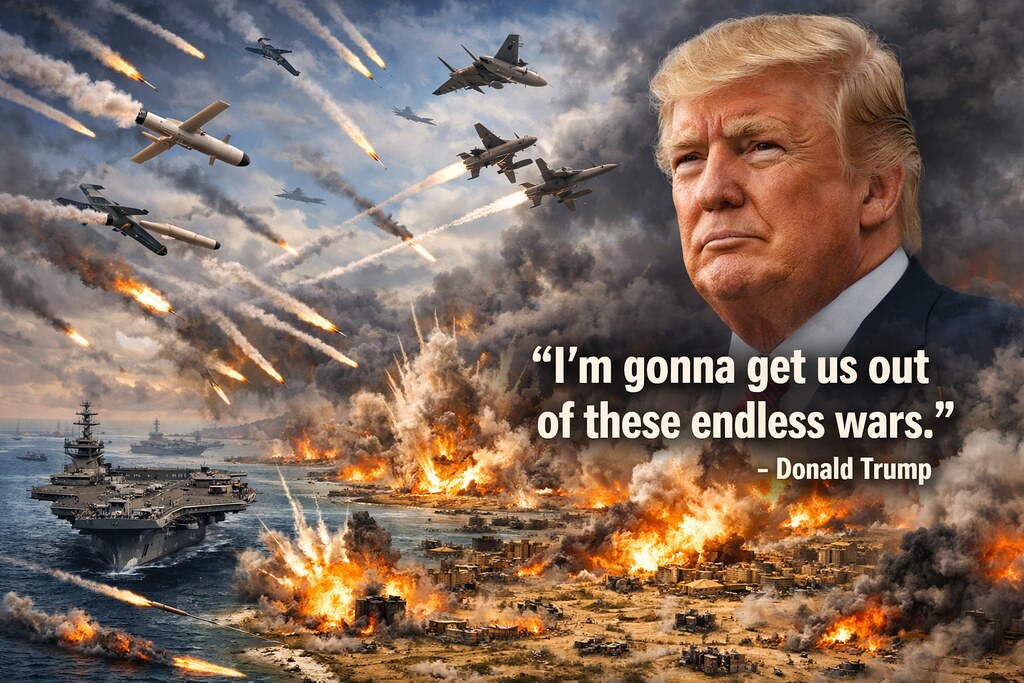
“I’m about to make a decision. We’re all ready for it,” Trump told Axios, adding that the next step would be a “massive attack” that would be “bigger than ever before.” These statements shook already turbulent energy markets after 12 consecutive nights of US strikes on Iran.
The threat came at a time when the Iranian Islamic Revolutionary Guard Corps announced that its night campaign targeted American military assets in Jordan and Kuwait. The Iranian Revolutionary Guard admitted to striking a communications tower in Kuwait, and described the attack as direct retaliation for the American attacks on Iranian communications infrastructure. Kuwait later confirmed that the Abdali border crossing with Iraq was also bombed by what it described as “enemy drones.”
Mohammad Akraminia, spokesman for the Iranian army, said in a statement, “The armed forces’ retaliatory attacks will continue as long as the American attacks on the country’s infrastructure and coastal areas continue,” noting that Tehran sees no reason to retreat while Washington escalates.
Iranian Foreign Minister Abbas Araqchi warned on Wednesday that Tehran would respond “with the principle of an eye for an eye” to any future US attacks, including strikes on Iranian civilian infrastructure. The operations carried out overnight by the Iranian Revolutionary Guard against Kuwait and Jordan showed that Tehran is ready to follow up.
The United Nations Security Council convened as the crisis worsened. “The situation is spiraling out of control. It is teetering on the brink of the unthinkable,” Secretary-General António Guterres told the council. “One crisis feeds another. One escalation leads to the next.” The Council did not take any action.
Brent crude rose above $100 a barrel on Thursday, the first breach of that mark since May, as Yemen’s Houthi movement expanded the confrontation by attacking two Saudi tankers in the Red Sea and declaring an official blockade of Saudi ports. The dual disruption of the Strait of Hormuz and the Red Sea has left the Gulf’s two vital sea lanes under threat simultaneously.
Al Jazeera’s Youssef Morey, reporting from Sanaa, cited Houthi sources warning that Saudi Aramco facilities “may become a future target” if Riyadh does not lift its blockade of Houthi-controlled ports. The Houthi announcement represents a calculated extension of the Iran-allied resistance campaign to include Saudi infrastructure, a front that had not been fully activated as of Thursday.
“Much of the world’s spare production capacity has already been used, while strategic and commercial oil inventories are lower than when the war began, leaving the market with fewer buffers against prolonged supply disruptions,” said Janiv Shah, vice president of Rystad Energy. According to Al Jazeera. This warning embodies what the oil market is pricing in: not just the current turmoil, but the absence of a buffer if the conflict escalates.
Congress tried to restrict the war. The House of Representatives this week approved a war powers resolution ordering the administration to halt the campaign against Iran, the fourth such vote since February, but the Senate did not move to support it. Republican senators have grilled Defense Secretary Hegseth about what America’s endgame looks like without getting a satisfactory answer. Trump maintains full scope of operations.
Trump’s framing of the upcoming strike as “bigger than ever” raises questions about remaining targets after 12 nights of raids on bridges, tunnels and communications infrastructure across Iran. He did not clarify whether the next escalation would reach nuclear facilities, command complexes or energy infrastructure. It has not been made clear what “larger” means in this context, nor has it been made clear what will follow.
The interim peace agreement signed by the United States and Iran last month has been effectively destroyed by the resumption of the air campaign. Guterres’s invocation of the term “the edge of the unthinkable” reflects an institutional recognition that traditional crisis management tools are not working. Shipping insurance rates for ships attempting to cross any of the choke points have reached levels not seen since the first weeks of the war. Trump is “close to a decision,” and the Gulf is waiting to find out what it is.

