
The indie parkour game that’s hard to put down
When I posted a pair of MOTORSLICE shorts on social media a few weeks ago, one of the comments was a quick observation that “the movement seems a little clunky.” It garnered a few likes and stood out to me, because after spending some time with the game, I can confirm that yes, the movement is clunky at times. But what the commenter didn’t really understand is that MOTORSLICE is also one of the most distinct and compelling indie games of 2026 so far, and clunkiness is the price of entry rather than the deciding factor.
MOTORSLICE is a third-person parkour and combat game from Brazilian indie studio Regular Studio, published by Top Hat Studios. It’s been compared to everything from Shadow of the Colossus to Mirror’s Edge to Nier: Automata, and the comparisons are all deserved even if none of them really clarify what the game is.
The setup
You play as P, a Slicer dropped into a vast empty megastructure with the mission of destroying all the machines inside. Your only companion is a hovering drone called Orbie, voiced through the game’s only sustained vocal performance (Kira Buckland, doing some of her best work). The story involves a post-human world where construction machines have gone rogue and someone has decided that P is the person who should clean them up.
What this “someone” wants, why P agreed, and what it all actually means are deliberately left vague. MOTORSLICE does not aim to present its world to you on a platter, which is either exciting or frustrating depending on your patience. I landed somewhere in the middle. In the final chapter, I wanted more context than the game was willing to give me, but I also accepted that the ambiguity was part of the design rather than being a hole in it.

The world deserves the hype
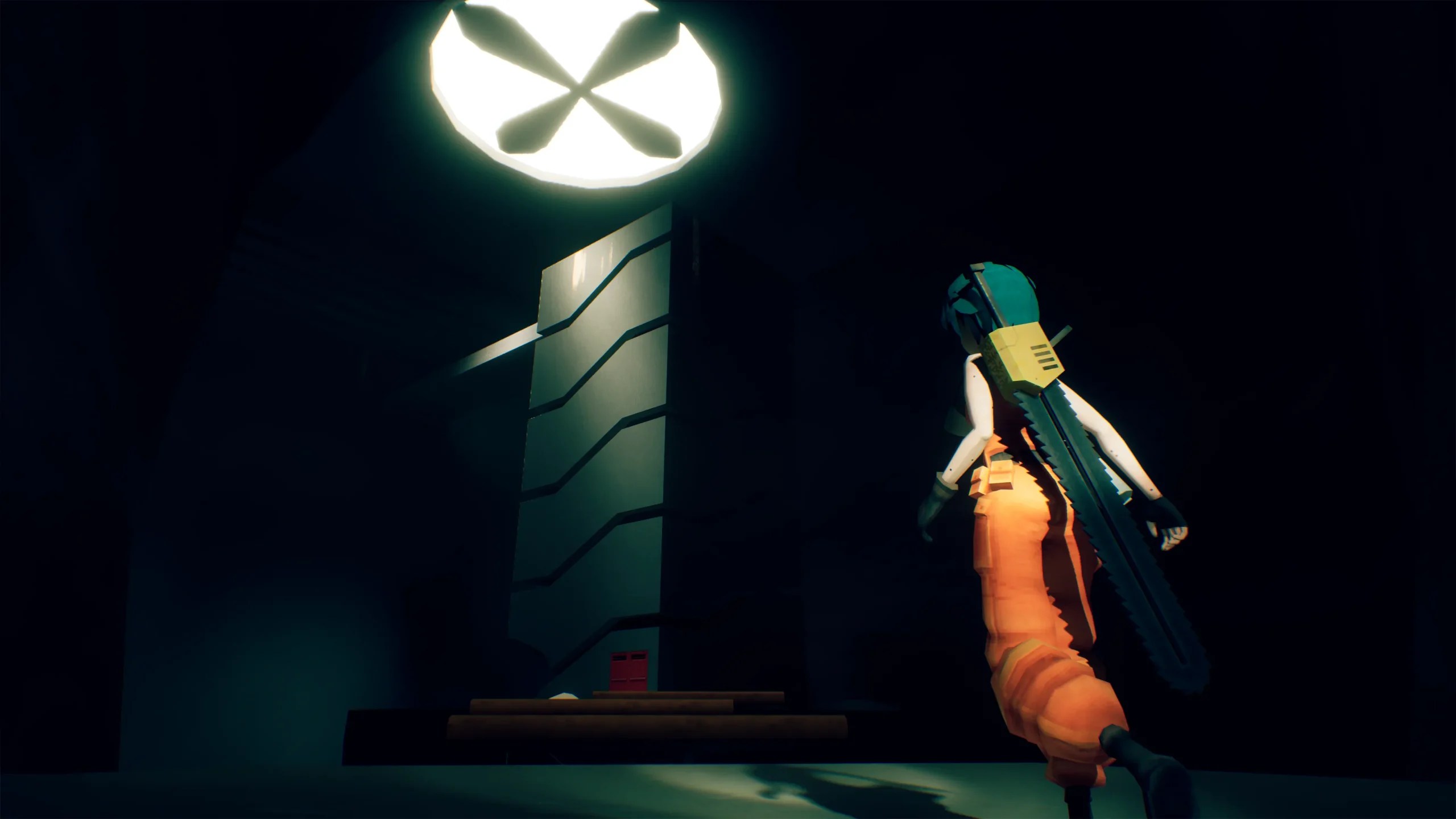
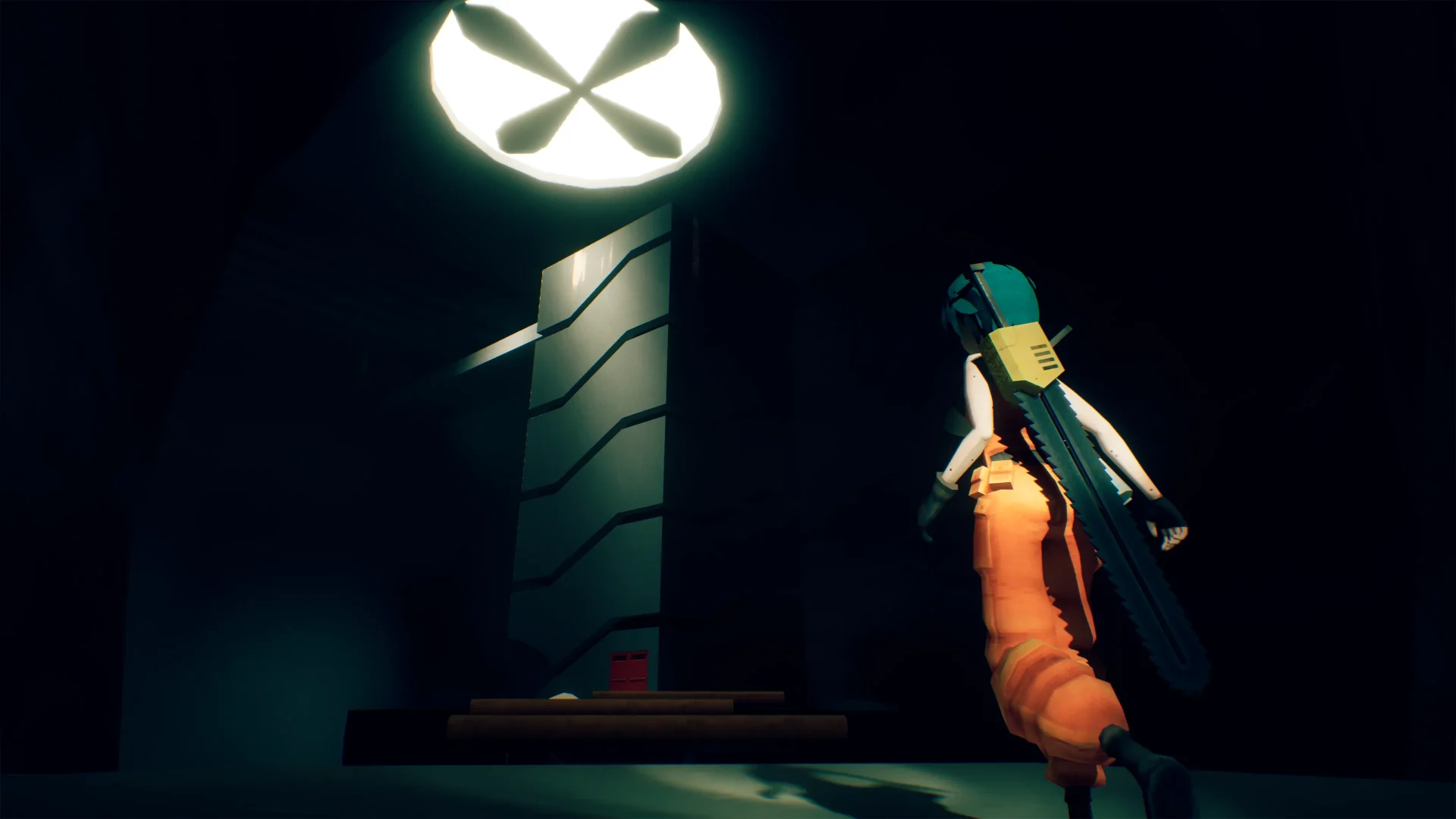
The first thing every review mentions and the first thing I want to talk about. The megastructure is glorious. Brutalist concrete pillars stretching into mists, brilliant views of blue sky glimpsed through dark corridors, vast architectural geometry that exists more to suggest impossible scale than to be physically navigable. It looks more like speculative architecture than a video game environment, and I mean that’s the biggest compliment I can pay it.
Regular Studio took the unusual step of using Unreal Engine 5 not for photorealism but for restraint. Surfaces are simple, textures are minimal, the color palette is muted, and the result is a world that lands harder emotionally than most thirty million dollar productions do. There’s a recurring visual motif where darkness closes in around P then opens into a new cavern of light, and it never stopped landing for me. This is arguably the best-looking indie game I’ve played this year.
The sound design carries the same ambition. The score relies on a cool electronic vibe, the diegetic audio of the chainsaw against metal is genuinely satisfying, and the little audio cues (P’s gasps as she dies and restarts, Orbie’s clipped tones, the wind through structures) all add to a sense of place rare in a game of this size.

The Motorslice Mechanic
This is the flagship verb of gameplay and this is where the game deserves its name. P carries a chainsaw, and some shaded panels around the world can be cut and mounted vertically or horizontally as a sort of mechanized wall. When it works, and most of the time, it feels truly cinematic. You stitch together jumps, slices, and wall runs in a state of flow that wouldn’t look out of place in The Matrix.
The standard parkour surrounding it covers all the moves you’d expect from the genre. Double jumps, ledge grabs, wall-runs, jumps, everything in between. None of this reinvents the wheel, but most of it feels good in the moment, and the Motorslice itself is the spice that makes the package worth eating.

Where it stumbles
Now the awkwardness, because there’s no point pretending it doesn’t exist.
The movement has a slightly inconsistent feel to it that becomes more evident the longer you play. The jumps have a floating tail that sometimes extends past the small platforms. Wall runs sometimes lock you in a direction you didn’t really mean. Pole climbing is introduced in a way that required me to do the same section three times to figure out what the game expected of me. None of these are catastrophic, but they are real, and on precision sections they bite.
The biggest problem, and the one I’ve read in every other review, is the camera. When you cut in a straight line with the engine, the camera follows you well. The moment you have to change direction in the middle of the slice, notably from horizontal to vertical, the camera and controls start to argue. You hold the slice button while trying to push the camera into the new heading while pressing jump and trying to land cleanly, and the result is a failure rate that feels more like a fight against the controls than the level. Generous checkpoints help manage frustration, but don’t eliminate friction.
I died A LOT during my playthrough, which isn’t unusual for the genre, but a lot of those deaths were the camera’s fault rather than mine (I like to think).

Boss fights
Each chapter ends with a colossal machine that must be taken apart, and these encounters are the game’s clearest homage to Shadow of the Colossus. You climb up, look for weak spots, cut out vulnerable areas, and gradually wear the thing down. They build up nicely over the course of eight chapters, with the later ones introducing environmental puzzles alongside the climb-and-slice loop. Lure a digger into a trap, spin industrial fans to throw him off balance, parry a chainsaw arm at exactly the right pace.
These fights are the centerpieces and they land for the most part. Some of them rely too much on the directional engine slicing that I complain about, meaning the difficulty spike comes more from camera friction and controls than real challenge, but the conceptual ambition is definitely impressive for such a small indie team.

P and Orbie
Between chapters, the game pauses for what it calls Slack Off sections. P leans against a wall, Orbie hovers next to her and the two talk. Dialogue is what divides. Some of them are tender and playful, some of them are genuinely funny, and others lean toward an affectionate register that’s either charming or striking, depending on your tolerance for that sort of thing.
Personally, I landed on Charming. The relationship between P and Orbie has more weight than I expected, and by the end of the game I was more invested in their dynamic than the larger mystery of the megastructure. This is a credit to Kira Buckland’s writing and performance, as the rest of the cast is mostly silent.
The most frustrating thing is that the story keeps hinting at deeper knowledge (who built the megastructure, why P is doing this, who the other Slicers are) and then refuses to pay anything. There’s an interesting plot point introduced in the final act that I wanted at least two more hours on, and the game just ends. I closed it wanting a sequel rather than feeling satisfied, which is a strange compromise. Less than fully satisfying, more than a waste of time.
How long, how much
Eight chapters, between ten and fourteen hours depending on how much side content you’re looking for (or how many times you die). There are collectible orb drones scattered throughout the levels that act as one-shot protection charms and feed achievements, but no lore rewards, which feels like a missed opportunity. Completers will probably add another two or three hours to chasing them.
It’s currently available on Game Pass on PC, which is also why it’s gotten more attention than most indie debuts this year. If you have a subscription, you have no excuse not to try it.

Is it worth it?
MOTORSLICE is the kind of indie game I want to recommend even though I can list its flaws in detail. The world is beautiful. The Motorslice mechanic is one of the most distinct movement systems I’ve used in a while. The boss fights above all for work. P and Orbie deserve a sequel.
The flaws are real, but they’re the kind of flaws that Regular Studio could fix in a patch cycle or follow-up. Camera issues during directional cutting, occasional movement inconsistencies, a story that holds back too much. None of these are deal-breakers if you know they’re there.
If you’re a fan of Shadow of the Colossus, Mirror’s Edge, Nier Automata, or the kind of indie game that aims for something truly interesting rather than a safe clone, MOTORSLICE is on your list. It’s not a perfect game. It’s a memorable moment, and in a year filled with sure-fire sequels and remakes, memorable counts for a lot.
A confident indie debut held back by camera friction and an under-told story, but Motorslice’s world design, boss fights, and mechanics make it one of the most distinctive games of the year.

